
Living in the US in the lead up to a national election is sure to increase your anxiety at the best of times. And experiencing it in 2024 is even more collywobbling. And then there is everything else going on. In these situations I’ve found that escape is always good. So, if you’re like me — and are looking for a welcome distraction — perhaps you’d like to join me on a journey some 380,000 kilometers from Earth: a journey to the Moon…
An Amazing Era
A few of you fellow crinklies might have grown up in the amazing era of NASA’s endeavors in the 1960s and 70s. The 1960s marked the dawn of the space era, but the most exciting period was from 1969 to 1972 when NASA successfully landed six manned spacecraft on the Moon. These were of course the Apollo Missions.
But how did they navigate there? Where exactly did they land? How far did these astronauts venture from their landing craft? And how did their excursions compare to the journeys us Earthlings take every day? To learn more, please join me on this amazing expedition…

Navigating to the Moon
Yours truly was a wee six years old when Apollo 11 landed, so almost too young to be impressed. But impressed I was.
If you’re a young ‘un, you might be a bit blasé about NASA’s efforts. After all, everyone’s BFF, Mr. Musk, seems to launch about 1,000 satellites every day. So what’s the big deal? Well let’s just say in 1969 things were a little more challenging.
For those of you who read the Map Happenings post on the birth of in-vehicle navigation systems, you might have been gobsmacked by the fact that the 1985 Etak Navigator came out before GPS, CD-ROMs and ran on an Intel 8088 CPU which had only 29,000 transistors. And you might be even more impressed when you compare that to Apple’s latest M4 chip: it has not a million more transistors than the Intel 8088, but a million TIMES more1.
But, by Apollo standards the Intel 8088 was like magic.
Imagine if you were fortunate enough to have talked to one of the engineers who developed the guidance and navigation computers for Apollo. I’m sure they would have given their two front teeth for something as powerful as an Intel 8088. In fact I have no doubt they would probably have promptly regaled Monty Python’s Four Yorkshiremen sketch — “You were lucky!”
By the way, speaking of Yorkshiremen, at the time Apollo 11 landed on the Moon in 1969 my family lived in the sheep farming country of northern England — the Yorkshire Dales to be precise. And our house was in a valley with no line of site to any TV signals, so we had to make do with the radio and printed newspapers. That didn’t stop yours truly from learning everything I could about Apollo. My most distinctive memory of the time was building a 1:144 scale Airfix model of the Saturn V rocket, complete with separate stages and an extractable Lunar Module. It was fantastic.

We finally got a television signal in time for Apollo 13. My grandmother was visiting at the time. I remember her exclaiming: “I’m not going to watch it. If I do, it’s sure to go wrong!”
But let’s get back to the Apollo guidance and navigation computers…
There were four guidance computers on Apollo:
- one for the Saturn V booster to get the astronauts off the launch pad and into Earth’s orbit
- one for the Command Module to get the astronauts from Earth’s orbit to the Moon’s orbit and back to Earth
- two for the Lunar Module: one for landing and subsequent ascent back to the orbiting Command Module and a separate emergency abort computer in case something went horribly wrong.
Designed by the bright lads and lasses at MIT, these computers were super advanced for their age. In the 1960s most computers filled multiple cabinets with electronics and had to be housed in large air-conditioned rooms. The Apollo Guidance Computer, or ‘AGC’, in the Lunar Module weighed just 30kg (66lbs) and was about the size of a small suitcase:


To get a sense of some of the challenges engineers were faced with to develop these computers, I recommend you watch this nine minute video by ‘Curious Droid‘. It’s seven years old, but still very informative:
The AGC in the Lunar Module, with only 2K of erasable memory (RAM) and 36K of fixed memory (ROM)2, had to do the complicated calculations to help the astronauts land on the Moon and return safely to re-dock with the Command Module. It was one of the first computers to use integrated circuits (ICs) for its CPU, but don’t get too excited: each IC contained just three (3) transistors. A far fly from the super advanced Intel 8088! Also, don’t assume this 30kg suitcase was filled with these diminutive ICs. It wasn’t.
Probably the most complex modules contained in the AGC were the extremely laboriously hand woven “core rope memory” modules for the fixed memory (or ROM).
What’s intriguing to me as a former software engineer is that all the software programs in the AGC were actually encoded in the hardware using the core rope memory. So, the software was actually hardware. A mistake made in painstakingly weaving these core ropes by hand could therefore have introduced a software bug. As one module of core rope memory took three months for someone to weave, making mistakes was incredibly expensive.
To give you an idea of just how complex the core rope memory was, here are some visuals. A single core rope module was about 30cm (12″) wide and a about 10cm (4″) tall:

Zooming in to see the detail. The number of wires and complexity of the weaving was astounding:

Here is a lady painstakingly weaving the wires in one of the modules:

So imagine the job: taking this big heavy code listing, and literally weaving it into hardware:

For a fascinating deep dive, read Ken Sherriff’s blog. As he says in his article:
At a high level, core rope is simple: sense wires go through cores to indicate 1’s, or bypass cores to indicate 0’s. By selecting a particular core, the sense wires through that core were activated to provide the desired data bits.
So the software was encoded in the hardware. And there were bugs.
In the case of Apollo 11 a bug was discovered in the code for the abort landing just one a month before the planned launch. If it ever manifested there was a chance it would have sent the lunar lander tumbling head over heels. Needless to say Neil Armstrong was not happy. As a result somebody had to get inside the already fully stacked Saturn V rocket, make their way into the Lunar Module, remove the AGC and extract the offending core rope module. The replacement had been painstakingly modified to correct the bug. This involved locating the offending wire from the many, many thousands of wires inside the module, terminating it at both ends and then threading a new replacement wire, this time through the correct cores.
Most of the staff tasked with weaving the core ropes were women. One of the most impressive women on staff was Margaret Hamilton. David Brock recounts the history in his article “Software as Hardware: Apollo’s Rope Memory” in IEEE Spectrum:
The supervisors responsible for overseeing the careful integration of changes and additions to the software were known as “rope mothers,” regardless of their actual gender identity. The rope mother’s boss, though, was a woman: Margaret Hamilton. Before Apollo, Hamilton worked as a programmer at MIT’s Lincoln Laboratory on the Semi-Automatic Ground Environment (SAGE) air-defense system. After MIT won the contract to supply the guidance and navigation system for Apollo, Hamilton got a job working on the systems software, and she eventually led the team that created the onboard flight software.

If I’ve succeeded in piquing your interest in the Apollo navigation computers, and you want to nerd out on the really gory details, then watch this superb 1965 interview with the MIT engineers who designed and developed the AGC:
All pretty astounding, and I’d frankly be surprised if today’s young MIT graduates could pull it off given the same constraints.3
The Six Apollo Landings
The Moon travels around Earth once every 27.322 days in an elliptical orbit, or an elongated circle. It is tidally locked with Earth, which means that it spins on its axis exactly once each time it orbits our planet. Because of this, people on Earth only ever see one side of the Moon. All the Apollo landings were on the ‘near side’ — the side we can see from Earth.
[BTW: China is the only country to have successfully landed spacecraft on the far side of the Moon. This first landing was only a fairly recent accomplishment: achieved in January 2019. Earlier this year China also became the only country to have successfully collected lunar samples from the far side of the Moon and return them safely to Earth.]
If you’ve ever done any geospatial work, you may have done something called ‘site selection’. And you don’t have to be a geek to do it. For example, many people use off-the-shelf geospatial software to select the best site for a retail store or the best site for a smart locker. The folks at NASA went through a similar process when selecting potential landing sites for each of the Apollo missions.
Using images from uncrewed lunar orbiters that were launched in 1966 and 1967, NASA looked for sites that met the following criteria:
- Smoothness of the area: the sites should have relatively few craters;
- Approach paths: there should be no large hills, tall cliffs or deep craters which could cause incorrect altitude signals to the landing radar;
- Propellant: the sites were selected to allow for the expenditure of the least amount of propellant;
- Countdown delays: the sites were selected to allow for the ‘recycling time’ of the Saturn V if the countdown were to be delayed;
- Free-return: the sites must be within reach of the Apollo spacecraft in the free-return trajectory, that is: a path that would allow a coast around the Moon and safe return to Earth without any engine firings should a problem arise on the way to the Moon;
- Lighting: for optimum visibility during the landing approach, the Sun angle should be between 7 and 20 degrees behind the LM; for any given site, this results in a one-day launch window per month;
- Slope: the general slope of the landing area must be less than 2 degrees.
For Apollo 11 this selection process narrowed it down to five sites. All were within an area on the visible side of the Moon between 45 degrees east and west longitude and between 5 degrees north and south of the lunar equator.
A similar site selection approach was taken for the other six planned missions (Apollos 12- 17), each one being slightly more ambitious. Of course Apollo 13 never landed. But five subsequent missions did. Here is a marvelous video created by Ernie Wright (USRA) and Noah Petro (NASA/GSFC) of NASA’s Scientific Visualization Studio showing the six landing sites. The timing of the landings and the phase of the moon are all relatively correct — notice the big gap between Apollo 12 and 14. [note: you may need to tap to play video]
Here’s a summary showing the locations and statistics for each mission:

Apollo 11 was certainly one of riskiest landings. Not only did the AGC throw error codes and reboot several times during the decent, Neil Armstrong encountered a rock field at the intended landing spot. He had to manually maneuver the lander to another smoother location. In doing so they almost ran out of fuel. The Lunar Module indicated just 17 seconds of fuel left when they touched down4. The final landing spot end up being about 7 kilometers (4.25 miles) downrange from the intended landing site.
To begin to understand the complications of the landing you need to get to know Peter Adler and Don Eyles. These were two of the ‘young experts’ at the MIT Instrumentation Lab — the Draper Lab — who worked on the software for the Apollo Guidance Computer. Peter recounts the story in his 1998 article on the “Apollo 11 Program Alarms“:
You have to constantly keep in mind the amazing — to anyone using a PC today — constraints we had to work with in programming the [Apollo Guidance Computer]. There were 36,864 15-bit words of what we called “Fixed” memory, which today would be called ROM, and 2048 words of “Erasable” memory or RAM. With only rare exceptions, all of the executable code was in the Fixed memory, along with constants and other similar data. Erasable memory was used for variable data, counters, and the like. With so little Erasable memory available, we were forced to use the same memory address for different purposes at different times. Thus, a location whose contents might be altitude-over-the-lunar-surface during the landing stage might have contained the results of a sextant sighting of a navigational star from the alignment program. I think there were some memory locations that were shared seven ways. You can imagine the testing we had to do to ensure that the same memory location was not being used by more than one program at the same time.
You also have to remember that, long before Bill Gates, we had developed a real-time multi-tasking operating system. There were interrupt-driven, time-dependent tasks — e.g., turn the [Lunar Module] Descent Engine on at the correct time — as well as priority-ordered jobs that dealt with less time-critical things. Each scheduled job has some erasable memory to use while it was executing.
During the descent, the Apollo Guidance Computer (AGC) repeatedly threw 1202 alarms and later 1201 alarms. This was due to the fact that repeated jobs to process rendezvous radar data were scheduled because of a hardware bug: a misconfiguration of the radar switches. As a consequence the AGC quickly ran out of space to store data in its erasable memory (or RAM). Peter continues to recount the story:
On Apollo 11, each time a 1201 or 1202 alarm appeared, the computer rebooted, restarted the important stuff, like steering the descent engine and running the [Display/Keyboard] (DSKY) to let the crew know what was going on, but did not restart all the erroneously-scheduled rendezvous radar jobs. The NASA guys in the [Mission Operations Control Room] knew — because MIT had extensively tested the restart capability — that the mission could go forward.
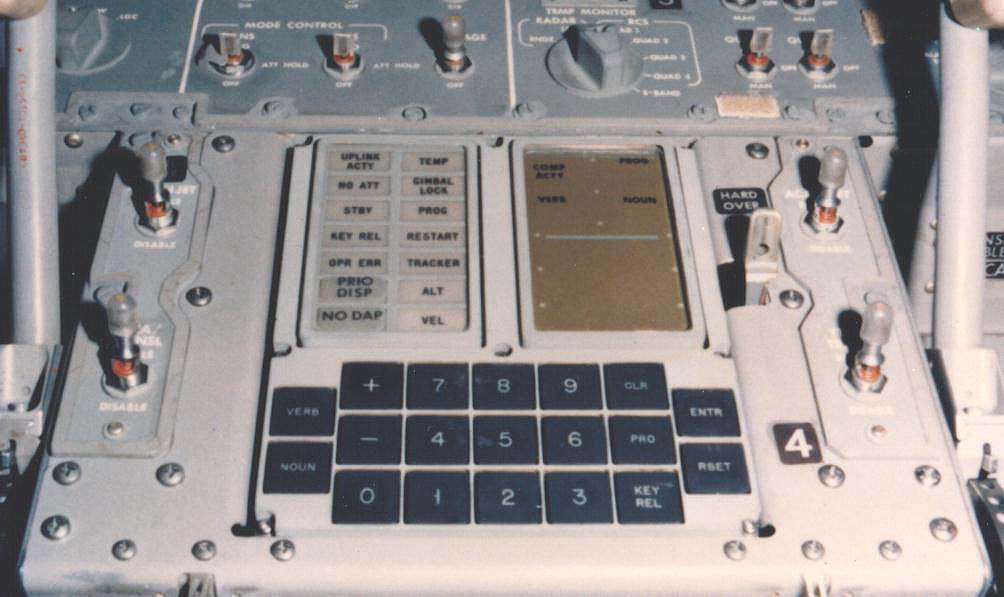
Apollo 11 wasn’t the only hairy landing. Coming eight months after the near disaster of Apollo 13, Apollo 14 suffered a critical issue: a loose ball of solder was floating around in zero gravity inside the ‘Abort’ switch in the Lunar Module and was randomly shorting it out. It was the young MIT engineer, Don Eyles, that came to the rescue. Stephen Cass and Christine Dabney recount the story in writing for IEEE Spectrum:
In the early hours of 5 February 1971, Don Eyles had a big problem: Apollo 14 astronauts Alan Shepard and Edgar Mitchell were orbiting the moon, preparing to land, but it looked like they were going to have to come home without putting so much as a single footprint on the surface. The only way to save the mission was for Eyles to hack his own software.
Now remember, the software was all encoded in rope memory hardware, so Eyles had to develop an extremely clever work around. It involved the astronauts having to punch in 61 very carefully typed instructions into the computer that would result in the abort switch signal being bypassed. He later won a NASA award for his efforts. Eyles talks about it in this IEEE Spectrum interview from 2018:
None of the other landings had particularly significant issues with the exception of Apollo 15. It apparently landed on a tilt of about 10 degrees. The design limit for Lunar Module ascent stage lift-off is variously stated as 12 or 15 degrees. So it was close to the limit, but no issue ensued.
Mapping the Extra Vehicular Activities (EVAs)
The excursions that the astronauts made for the first three landings were pretty limited as the astronauts didn’t bring along any Cybertrucks to cause havoc. As a consequence they were constrained by their own two feet and, in the case of Apollo 11, time. That all changed for the last three missions when the astronauts brought along their 210kg EV buggy — the Lunar Roving Vehicle.
It’s pretty interesting to look at how far they actually ventured and compare that to where you and I might travel on Earth.
Let’s start with Apollo 11.
Neil Armstrong and Buzz Aldrin didn’t spend much time outside the Lunar Module — only about 2.5 hours. Much of it was spent collecting a few rocks, planting a flag and setting up experiments. So they didn’t get too far.
Fortunately we have a way to see exactly where they went with the help of the the Lunar Reconnaissance Orbiter or LRO. Launched in 2009 this robotic spacecraft orbits the Moon at an altitude of 50-200 km (30-125 miles). LRO’s primary objective is to make fundamental scientific discoveries about the Moon. It contains a number of instruments, including a system of three cameras that capture high resolution black and white images and moderate resolution multi-spectral images of the lunar surface. The high resolution camera has about 0.5m resolution per pixel, so it’s good enough to spy on the Apollo landing sites. 😁
So here’s what we can see of the Apollo 11 landing site:

You can clearly make out the left-behind Lunar Descent Module5 and the path that the astronauts walked to the edge of a nearby crater. But at no time did they venture further than 60 meters (200 feet) from their spacecraft.
Let’s compare where they went on the Moon to a trip across Paris: [note: you may need to tap to play video]
So, for all the hard work of those intrepid explorers, they didn’t even get out from under the Eiffel Tower!
Apollo 12 was a little more interesting. On April 20, 1967, about two and a half years before Apollo 12 landed on the Moon, another spacecraft had landed. It was called Surveyor 3. The Surveyor missions are little remembered but impressive precursors to the Apollo missions. Starting with Surveyor 1 which landed in June 1966 and ending with Surveyor 7 which landed in January 1968 these uncrewed craft laid the groundwork for Apollo. Five of these spacecraft, Surveyor 1, 3, 5, 6 and 7, successfully soft-landed on the lunar surface. In addition to demonstrating the feasibility of lunar surface landings, the Surveyor missions provided photos and the scientific and technological information needed for the Apollo manned landing program.
Why was Surveyor 3 so interesting? Well the Apollo 12 astronauts, Commander Charles “Pete” Conrad and Lunar Module Pilot Alan Bean, landed the Lunar Module “Intrepid” in the Ocean of Storms, a mere 160 meters (535 feet) from the robotic Surveyor 3 lander. A pretty amazing feat. You can get an idea of how precise the landing was by looking at this photo of Alan Bean inspecting the Surveyor with the Lunar Module in the background:

The Apollo 12 astronauts were much more energetic than their Apollo 11 counterparts. Over the period of their 31 hour stay on the Moon they made two “extra vehicular activities” (EVAs) for a total of almost eight hours trudging across the Moon. Again comparing their travels to a trip across Paris: this time they made it out from under the Eiffel Tower, across the Seine to the Trocadéro! [note: you may need to tap to play video]
Apart from the scary loose ball of solder floating around inside the ‘Abort’ switch, Apollo 14 went off without a hitch. Astronauts Alan Shepard and Ed Mitchell landed the Apollo 14 Lunar Module in the Frau Mauro formation on 5 February 1971. They stayed on the lunar surface for 33 hours, during which they performed two EVAs totaling a little over nine hours. Just like their predecessors they set out to beat the Guinness Moon Record for distance traveled:

On the second EVA, shown in green, the crew made a round-trip traverse of 2.5 kilometers (1.5 miles) toward the rim of Cone Crater, east of the landing site.
On to the last three missions: Apollo 15, 16 and 17. These were effectively “Apollo 2.0” with beefed up Command, Service and Lunar Modules designed to support longer stays. The main upgrade though was the addition of the Lunar Roving Vehicle (LRV) which was strapped to the side of the Lunar Module and subsequently deposited on the lunar surface like a fold down Murphy Bed:
Just like the first road cars, the LRV enabled ambitious exploration, allowing the astronauts to roam far from their humble Airbnb:

Here’s a map of Apollo 15’s drives across the moon, giving you an idea of the hilly terrain. The Apennine Mountains are 3,000 meters (10,000 feet) high to the east of the landing site, which required an unusually steep landing approach:

When you look at the map of their tracks a question starts to come to mind. Just how did they find their way around? Open their iPhone and bring up Google Maps? Well it turns out the Lunar Rover did have some navigation aids. There was no GPS, so it had to rely on dead reckoning. Each of the four wheels of the Rover were driven and also had odometers. Compasses on the Moon are useless as the Moon has no magnetic core. Instead the heading had to be determined from a gyro, which was initially calibrated by measuring the pitch and roll of the Rover using an attitude indicator and measuring the Rover’s orientation with respect to the Sun using a “Sun shadow device”. Here’s a picture of the Rover’s dashboard: you can clearly see the bearing and distance indicators, as well as the speedometer:

I’ll end this post with one final set of maps: the journeys of Apollo 17’s astronauts. Commander Eugene Cernan and Lunar Module Pilot Harrison “Jack” Schmitt landed the lunar module Challenger on December 11, about 240 meters (800 feet) from the pre-planned landing site. Cernan and Schmitt performed three moonwalks totaling just over 22 hours. At one point they traveled 7.4 kilometers (4.6 miles) away from the safety of the Lunar Module, the farthest during the Apollo program. To get an idea of just how far that was let’s compare their journeys to a trip across Manhattan: you can see that they made it as far as north as the Bronx and as far south as the Brooklyn Bridge: [note: you may need to tap to play video]
Or, if you’re more familiar with London, you’ll see their first EVA (in green) started from Harrods with a short trip to Battersea Park. Their second EVA (in Yellow) went from Harrods, to Regent’s Park, over to the City of London, and back through Trafalgar Square and St James’ Park. But their third and final EVA (in Blue), took them all the way from Harrods to Kew Gardens and Richmond-Up-Thames: [note: you may need to tap to play video]
If you’re wondering what it looked like from their perspective, here’s a photo they took on their second EVA. Far, far away in the distance you can just about make out the Lunar Module: [note: you may need to tap to play video]
So, does it make you feel lonely? Or do you want to return to the mayhem of planet Earth?
Acknowledgments
- NASA
- Peter Adler and Don Eyles of MIT
- Ernie Wright (USRA) and Noah Petro (NASA/GSFC) of NASA’s Scientific Visualization Studio
- David Brock, Stephen Cass, Christine Dabney: writing for IEEE Spectrum
- The Lunar and Planetary Institute (LPI)
- Curious Droid on YouTube
- Monty Python
- The London Telegraph newspaper
Further Reading and Viewing
Moon Trekking and Landing Sites
- Do your own “moon trekking” at https://trek.nasa.gov/moon
- “The Apollo Lunar Surface Journal“: NASA
- Website for the Lunar Reconnaissance Orbital Camera (LROC): Credit LROC
- Downloadable high resolution animations of the six Apollo landing sites: credit NASA’s Scientific Visualization Studio
The Apollo Flight Computers
- The Apollo Flight Journal: “The Apollo On-board Computers” by Phill Parker.
- “Inside the Apollo Guidance Computer’s core memory” by Ken Shirriff
- “Software woven into wire: Core rope and the Apollo Guidance Computer” by Ken Sherriff.
- CuriousMarc: 50 minute YouTube video delving into the Apollo Core Rope memory. This team restored an Apollo Guidance Computer to get it running again. Watch the video to find out how.
- “The Apollo 11 Program Alarms“: Peter Adler, MIT.
- “Light Years Ahead | The 1969 Apollo Guidance Computer“: excellent, nerdy presentation into the Apollo 11 program alarms by Robert Wills.
- “Don Eyles: Space Hacker This programmer saved the Apollo 14 mission with a few dozen keystrokes“: Stephen Cass and Christina Dabney in IEEE Spectrum.
- Sunburst and Luminary: An Apollo Memoir by Don Eyles, recounts his story of developing the onboard software for the Apollo spacecraft.
Other Items of Interest
- The full Apollo 11 Astronaut communications voice transcript: NASA
- The Lunar and Planetary Institute (LPI): Apollo Missions
- List of all missions to the Moon: crewed and uncrewed. Published by Wikimedia
- Hack the Moon: a website about the people, the tech and the missions that made the Apollo program possible
- The Yorkshire Dales
Footnotes
- The Apple M4 chip has approximately 28,000,000,000 transistors. That’s 28 with a ‘B’. ↩︎
- These were 16 bit words, so 2048 x 16 bits of RAM and 36,864 x 16 bits of ROM. 15 of the sixteen bits were for data and one was for parity. ↩︎
- By the way, just for fun I asked ChatGPT if it was up to the task of creating a program to land on the moon. As is becoming all too common, ChatGPT misunderstood and made mistakes. It didn’t understand the memory constraints so I had to correct it. Here is the full chat log. ↩︎
- Actually it was later found that Apollo 11 had about 45 seconds of fuel left. Sloshing in the fuel tank during Armstrong’s search for a safe landing site caused the fuel gauge to give an inaccurate reading. ↩︎
- For a better understanding of what was left behind watch this video of Apollo 17 lift-off from the Moon. ↩︎